
Key Takeaways
- Starting an RIA involves more than registration. It is also an operational design project. Decisions on compliance, fees, and technology in the first six months can have long-term implications for how the firm operates.
- Compliance planning can begin well before launch, and designing the compliance program before filing Form ADV can help firms align their disclosures with their intended policies and practices.
- When selecting a custodian, newer firms may encounter different service levels, pricing arrangements, or technology access than larger firms.
- Fee structure is an important component of a new firm's economic model and may become more difficult to change as the business grows.
- Manual workflows for analyzing prospect portfolios and creating proposals can become a source of friction and consume advisor capacity.
Most guides on starting an RIA read like a regulatory filing checklist: form an LLC, file your Form ADV, pick a custodian, and you're in business. Registration is only one part of launching an RIA. Founders also need to consider the operating infrastructure that will support client acquisition, service, compliance, and growth once the firm is live.
That includes choices made before and after filing, such as how a firm structures compliance from day one, how it evaluates custodial relationships, how it approaches fee architecture, and how it builds a portfolio workflow that supports preparation and presentation without creating unnecessary manual work.
This guide covers both the regulatory mechanics and the operational infrastructure most checklists skip. We will walk through the full path from model selection through registration, compliance, custodian selection, fee architecture, and the technology workflow that ties it all together.
Choosing Your Advisory Model Before You File Anything
One of the most consequential decisions happens before any paperwork is filed: choosing the firm's fundamental structure. For an advisor at a wirehouse with, say, $80M in portable AUM, the default assumption is often to launch a pure independent RIA. But that is only one path. Founders may evaluate independent RIA, hybrid, broker-dealer, or other supervisory structures with qualified legal and compliance professionals, each with different economics and operational considerations. Before going further, there are three decision axes worth evaluating.
First is the choice between a fee-only RIA and a fee-based model. A fee-only firm, as the name implies, is compensated solely through client fees (AUM-based, flat, or hourly). A fee-based model allows for both client fees and commissions from selling products like insurance or annuities. This is not just a philosophical choice, it affects revenue sources, disclosures, operating structure, and how the firm positions its value to clients. The applicable obligations can vary based on the firm's circumstances.
Second is solo practice versus an ensemble firm. A solo advisor keeps 100% of the revenue but may encounter capacity considerations as the firm grows. An ensemble practice splits the economics but allows for specialization, shared overhead, and a more scalable growth path. Modeling the unit economics of both paths factoring in compliance, tech, and office costs is an important exercise before forming the legal entity.
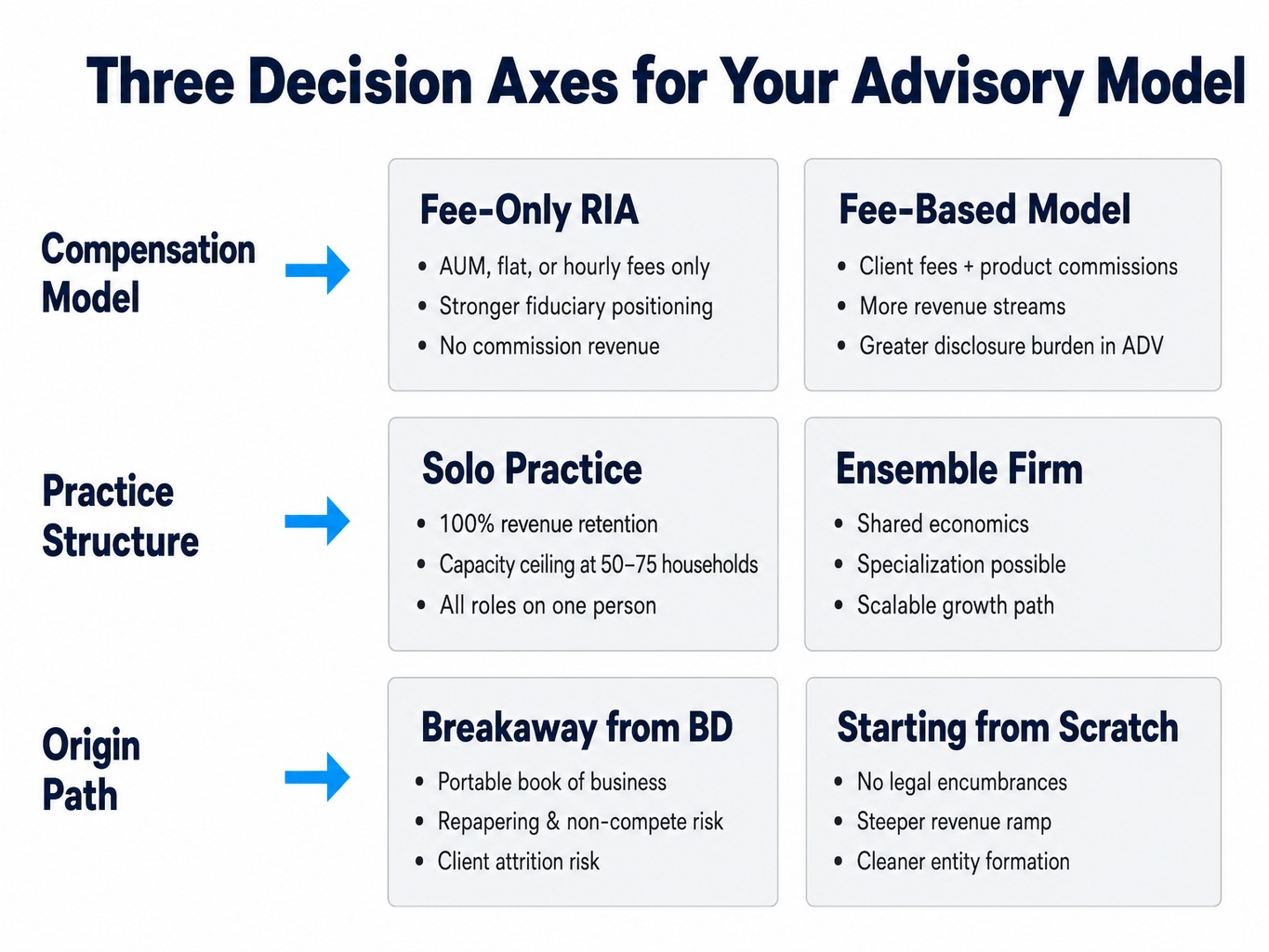
Finally, consider the difference between a breakaway from a broker-dealer and starting from scratch. A breakaway advisor brings a book of business, but the transition can involve repapering accounts, navigating non-compete agreements, and managing client attrition risk. Starting without an existing book presents different acquisition and revenue-ramp considerations.
Registration and Licensing: What You Actually Need to File
Registration is one part of launching a firm, but the more useful framing here is understanding how regulatory jurisdiction and individual qualification requirements may apply to the business model you are building. The core distinction is between where a firm registers and what credentials or qualifications individual advisors may need, with the details varying based on the firm's structure, size, and jurisdiction.
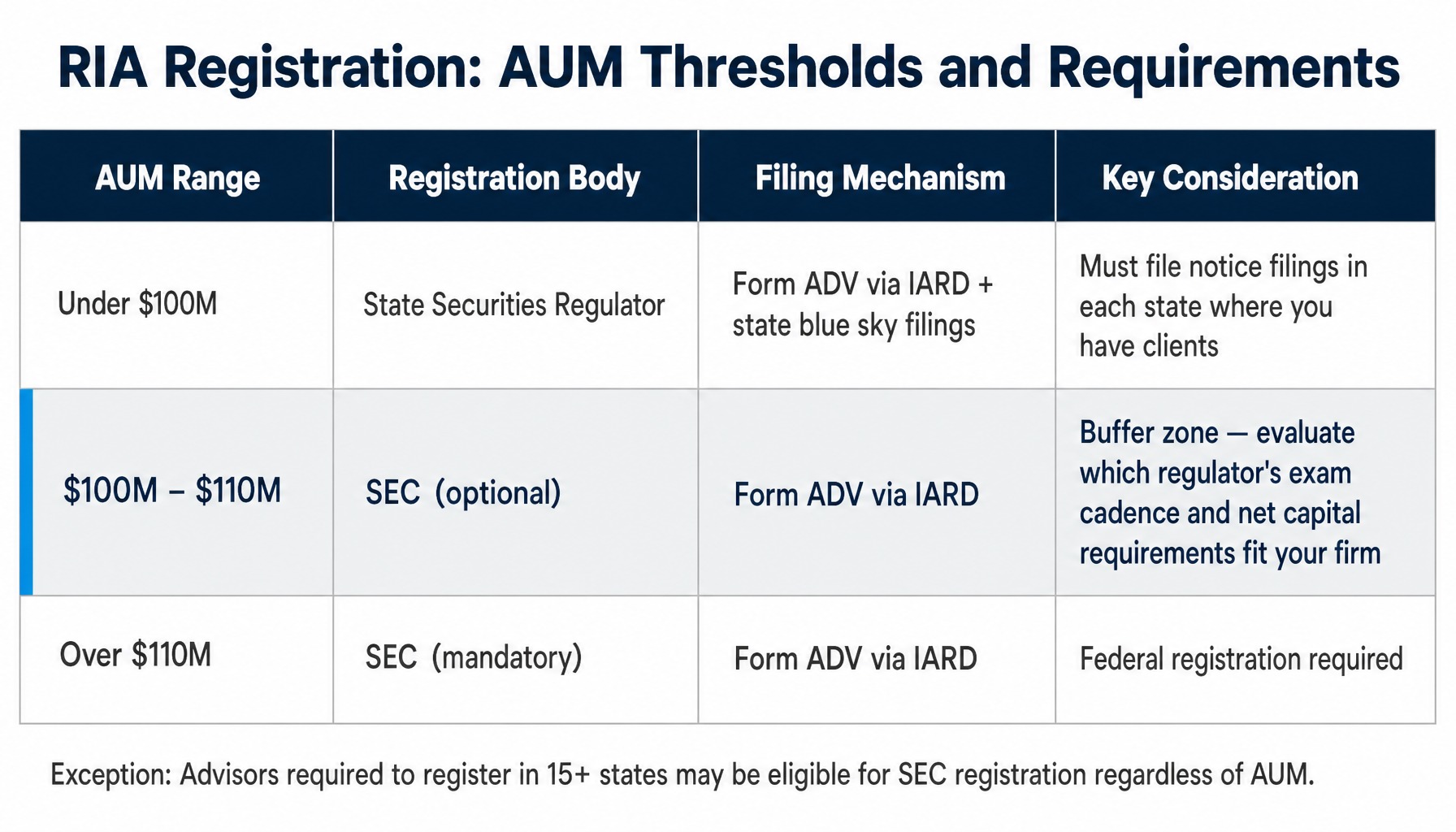
Regulatory thresholds that influence whether a firm registers with the SEC or a state regulator are often tied to assets under management, but they are also connected to broader operating considerations such as examination oversight, recordkeeping expectations, and how a firm approaches multi-state relationships. If a firm's size or footprint changes over time, its registration status may change as well. Firms should consult qualified legal counsel on the specific thresholds and requirements that apply to their situation.
SEC Registration vs. State Registration: AUM Thresholds and Filing Mechanics
The Investment Advisers Act of 1940 establishes the broad framework for who regulates an advisory firm. In practice, firms often evaluate registration at the state or federal level based on a combination of assets under management, geographic footprint, and other eligibility factors.
- State-level registration is commonly associated with smaller firms or firms earlier in their lifecycle, often using Form ADV through the IARD (Investment Adviser Registration Depository) system along with any applicable state notice or related filings.
- Federal registration may become relevant as a firm's size, complexity, or multi-state presence evolves.
- Between those two ends of the spectrum, firms may encounter transition points or exceptions that depend on their facts and circumstances.
Because these rules can include thresholds, transition provisions, and jurisdiction-specific nuances, firms should verify the current requirements with qualified counsel. For all levels, Form ADV Part 2A (the "brochure") is an important client-facing disclosure document describing the firm's services, fees, and business practices.
Licensing Exams: Series 65, Series 66, and What Your State Actually Requires
The firm itself does not take an exam, individual Investment Adviser Representatives (IARs) do. Qualification requirements can depend on an advisor's background, current registrations, professional designations, and the rules of the relevant jurisdiction.
Exams such as the Series 65 or Series 66 are commonly discussed in connection with IAR qualification, but they are best understood as examples of how jurisdictions may evaluate advisor eligibility rather than as a one-size-fits-all path.
In some cases, an advisor's existing registrations or professional designations may affect what additional qualification steps are needed. Because the details can vary, firms should confirm all licensing and qualification requirements with qualified counsel before filing.
Building a Compliance Program Before You Need One
Compliance planning can begin before the ADV is filed and the first client is onboarded. The key operational point is not memorizing a list of requirements, but making sure the firm's documented policies reflect how work will actually be done day to day. A compliance manual is not a compliance program, the manual is a document, while the program is the set of living procedures, review habits, and supervisory workflows that support the firm's disclosures and operations.
Imagine a solo advisor who downloads a generic ADV brochure template. Eighteen months after launching, they face a routine state examination and discover their actual billing process done manually in a spreadsheet does not match the sophisticated, multi-tiered fee procedure described in their ADV. This kind of gap can create challenges when a firm's disclosures and day-to-day practices diverge.
Building compliance infrastructure before filing can help firms align their disclosures with their intended operating practices. In practical terms, that often means establishing a documented approach to supervision, recordkeeping, business continuity, data handling, and role ownership that fits the size and complexity of the firm rather than copying a generic template.
Technology can also help firms organize recurring compliance responsibilities, maintain documentation, and keep internal processes more structured over time. Designing this framework from day one can support a more consistent approach to ongoing compliance responsibilities.
Custodian Selection: Negotiating Terms When You Have No Leverage
Newer or smaller firms may have different service levels, pricing arrangements, and technology access than larger firms, making it important to understand the specific offering available to the firm. The terms accepted at launch can also create long-term operational implications.
Custodian selection can be viewed not just as a feature comparison, but as a business relationship with downstream workflow implications. Integration capabilities, service models, and bundled tools can vary meaningfully across providers and firm sizes.
Instead of focusing only on brand, firms may want to consider questions such as:
- Technology Integration: How deeply does the custodian integrate with your core tech stack, including CRM, financial planning, and portfolio analytics?
- Transition Support: For breakaway advisors, what level of operational support will the custodian provide for repapering client accounts?
- Pricing Transparency: Are ticket charges, platform fees, and other costs clearly disclosed?
- Service Levels for Smaller Firms: Will the firm have a dedicated service contact, or a more centralized support model?
- Model Marketplaces & TAMPs: Does the custodian offer access to third-party models if the firm does not plan to manage portfolios itself?
Choosing a custodian is a long-term strategic decision with significant downstream workflow implications, which is why understanding the details of the offering can be worth the effort.
Read more: Operational Visibility for Wealth Management Growth | VRGL
Structuring Fees That Are Competitive Without Being Unsustainable
New firms may consider several factors when establishing their initial fee structure, including competitive positioning, service model, and operating costs.
The core decision is between AUM-based fees (with breakpoints), flat retainer fees, hourly fees, or subscription models. This choice affects not just revenue but client perception, ADV disclosures, and billing operations. When structuring fees, firms may want to consider:
- Billing in Arrears vs. Advance: Each approach has different implications for cash flow, client experience, and administration.
- AUM Breakpoints: Tiered pricing structures can affect how fees adjust as client assets grow.
- Flat-Fee or Subscription Models: These are alternative structures firms may evaluate depending on the client segment and service model.
Clear analytical comparisons can help advisors communicate the value and rationale behind their recommendations.
Building a Portfolio Workflow That Scales Beyond You
Technology planning can easily become a list of individual software categories: CRM, portfolio management, and financial planning. Another useful lens is the workflow that connects them, specifically how data moves from client intake through analysis, proposal, and presentation. Consider an illustrative scenario: a founder purchases a CRM, a planning tool, and an accounting system before launch, but has no defined process for how a prospect's holdings will be analyzed and translated into a client-ready proposal. The tools do not connect, and the workflow does not exist.
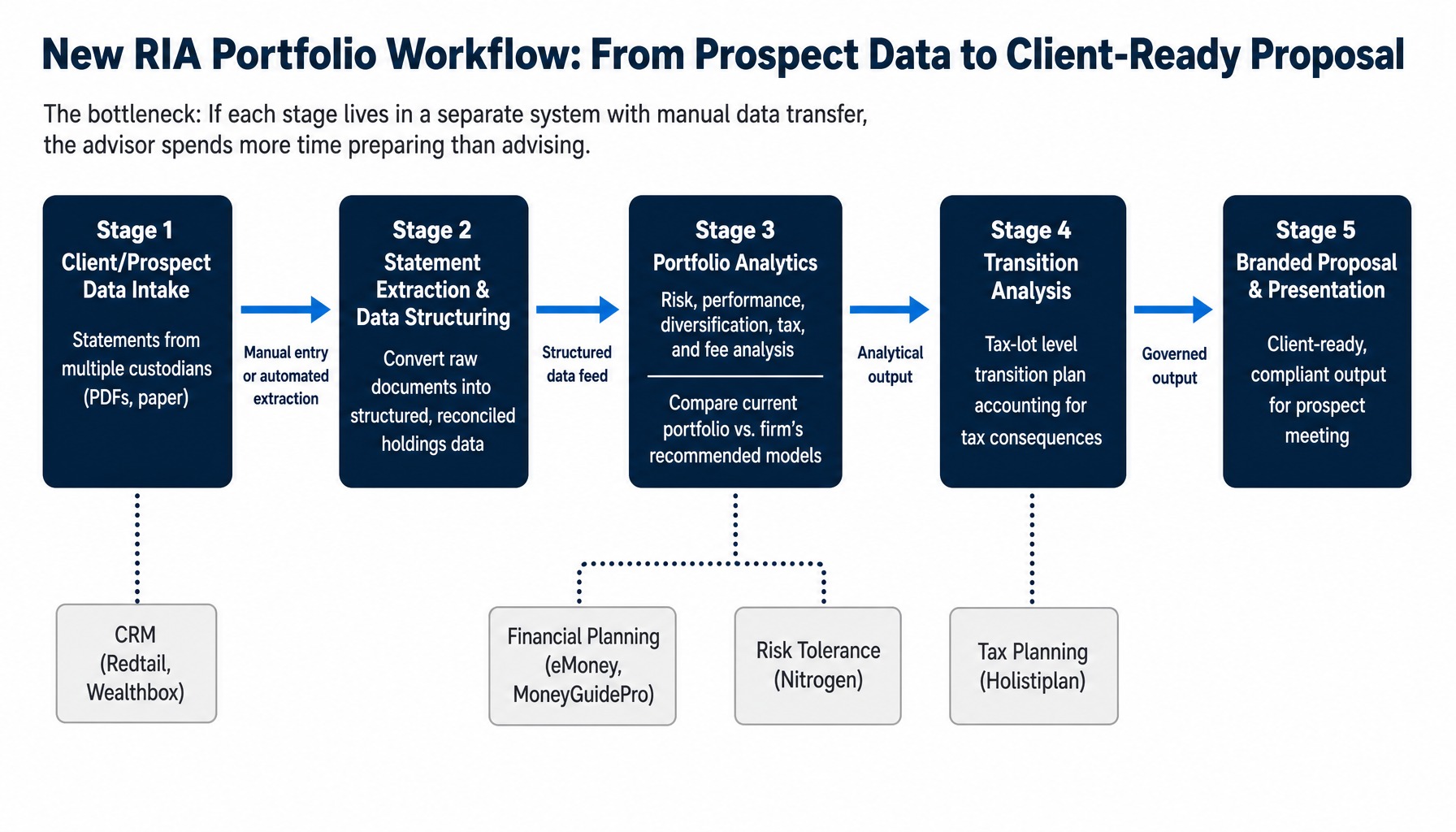
Consider a common workflow a new RIA may need to support. A prospect brings in statements from three different custodians. The advisor needs to extract the holdings, run risk and fee analysis, compare the portfolio against the firm's recommended models, build a transition analysis that accounts for tax consequences, and present the results in a branded, compliant proposal all before the next meeting.
If each of those steps lives in a separate system with manual data transfer between them, the advisor spends more time preparing than advising. The technology stack includes key categories:
- CRM
- Financial Planning
- Risk Tolerance
- Tax Planning
- Portfolio Analytics & Proposal Generation, which can serve as a connector between portfolio data and client-ready analysis.
The difference between a portfolio management system and a portfolio analytics workflow is that the management system tracks positions and executes trades, while the analytics workflow is the upstream process of ingesting prospect data and producing a recommendation. A connected workflow can help reduce manual handoffs and create additional capacity.
Read more: How to Create Winning Proposals: 3 Tips for Advisors | VRGL
How VRGL Supports the New-Firm Workflow
The pattern described above can consume meaningful advisor capacity. When the workflow between prospect data and a client-ready deliverable depends on manual steps across disconnected tools, the time cost grows with every new prospect.
Repeatable acquisition workflows help address this by connecting data intake, analysis, and proposal generation into a single sequence rather than a series of manual handoffs.
VRGL is designed as a Growth Platform for wealth management firms, the configurable system of work behind advice that supports acquisition, engagement, and firmwide consistency. Within that platform, VRGL Core provides the foundational workflow from data intake through client-ready deliverables.
For a prospect with statements from three custodians, the workflow begins with Statement Extraction, which converts PDF documents into structured data in minutes. From there, objective analytics across performance, risk, diversification, taxes, and fees compare the prospect's current state to the firm's proposed models. The proposal and reporting layer then generates branded, client-ready output for the meeting.
VRGL does not replace advisor judgment, provide investment advice, handle custody, or execute account transitions. It supports the data, analytics, and presentation layer that helps advisors prepare and communicate their own recommendations more efficiently and with less manual friction.
For a solo advisor starting a new RIA, this means the acquisition workflow can be repeatable from the start. For a firm planning to become an ensemble practice, it means the core workflow is governable from day one.
See how VRGL can support the acquisition workflow for new and growing advisory firms.
Conclusion
Starting an RIA involves more than registration. It is also an operational design challenge. Decisions about compliance infrastructure, custodian relationships, fee architecture, and portfolio workflow in the first six months can create long-term implications for how a firm operates.
Registration and licensing are important parts of the launch process. The other major consideration is building the systems that support consistent, repeatable client service and internal execution from day one. Treating the launch as both a regulatory and operating foundation can help firms create a repeatable structure for how work gets done as the business evolves.
This article is for informational purposes only and does not constitute investment, legal, tax, regulatory, or compliance advice. VRGL is a technology platform and does not provide financial advice, investment recommendations, or regulatory guidance. Firms should consult with qualified legal, compliance, and tax professionals when making registration, licensing, and operational decisions.
Frequently Asked Questions
How long does the RIA registration process typically take from initial filing to approval?
Timing can vary meaningfully based on registration type, jurisdiction, filing completeness, and regulator review processes. Firms typically benefit from building adequate time into their launch planning and confirming expected timelines with qualified legal or compliance professionals.
Can I start an RIA as a solo advisor without any team or support staff?
Yes many RIAs launch as solo practices. The firm owner may serve as the Chief Compliance Officer, lead advisor, and operations manager simultaneously. Managing multiple roles can make workflow efficiency particularly important for solo firms.
What errors and omissions insurance coverage should a new RIA carry?
E&O insurance and related risk-management coverage can be an important consideration for RIAs. Coverage structure and amounts vary based on firm size, business model, jurisdiction, and other circumstances. Firms should consult with insurance professionals experienced in advisory firm coverage to determine appropriate levels.
How can a new RIA evaluate whether to use a TAMP or build investment models in-house?
TAMP models and in-house model approaches can differ in cost, customization, operational involvement, and provider support. The tradeoffs vary by provider and by the firm's operating model. The right choice depends on what responsibilities the firm wants to retain internally and how central investment management is to its value proposition.
What are the ongoing compliance obligations after an RIA is registered?
Ongoing compliance responsibilities can include regulatory filings, recordkeeping, policy maintenance, and periodic reviews, depending on the firm's jurisdiction and operating model. Because these obligations can vary, firms should review the applicable requirements with qualified legal and compliance professionals.
How do breakaway advisors transition client accounts from a broker-dealer to a new RIA?
Breakaway transitions can involve new account documentation, custodian coordination, client communication, and review of any contractual or legal considerations tied to the advisor's prior firm. The exact process can vary based on the advisor's agreements, transition structure, custodian, and jurisdiction.